
News and Information
Stainless Steel: The Standard for Commercial Kitchens
July 8, 2026
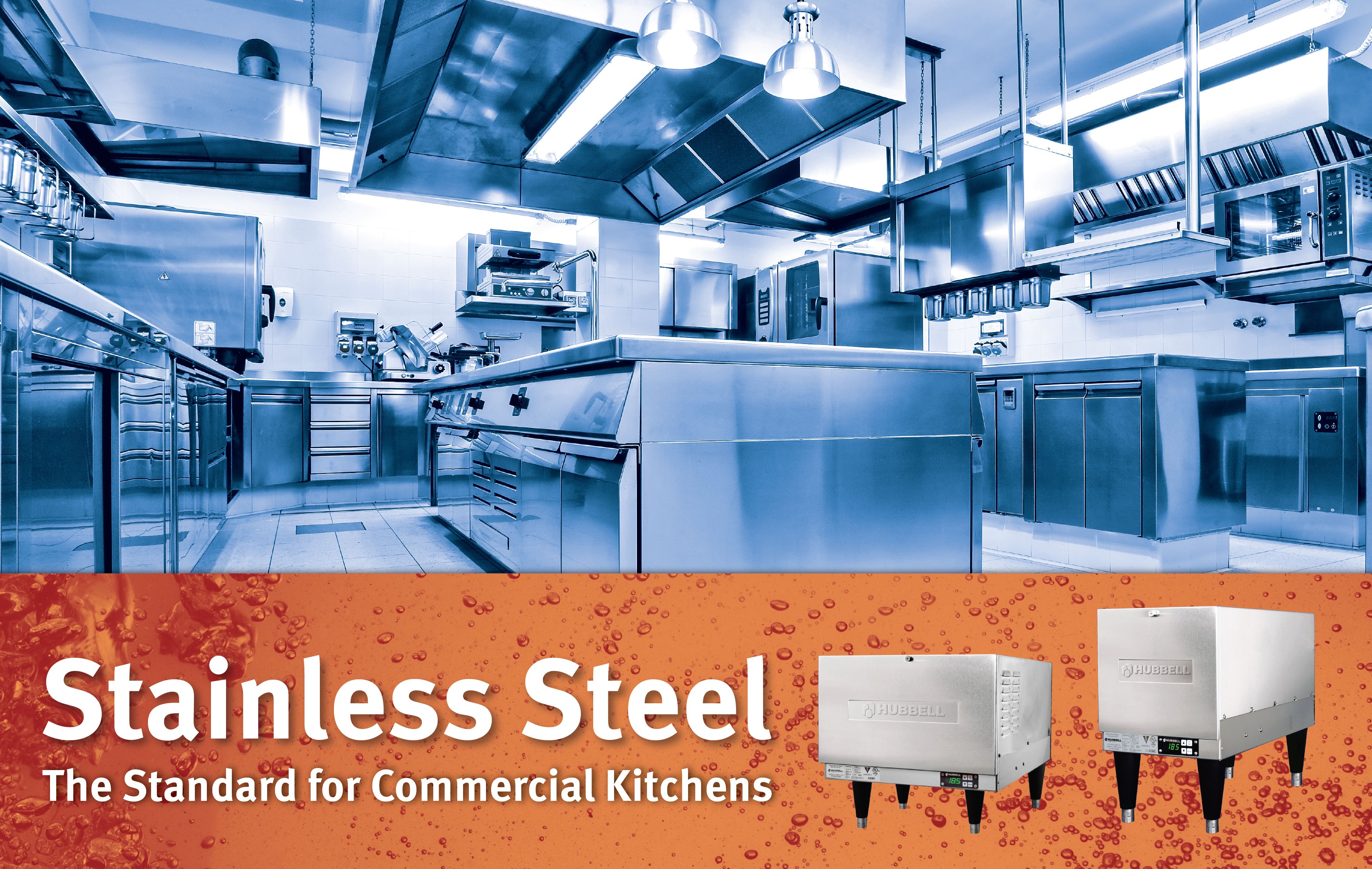
Commercial kitchens operate under a lot of pressure. Producing hundreds or thousands of meals requires handling everything from raw meat and ready-to-eat foods to hot liquids and caustic chemicals. With all of this at play, a lot can go wrong.
According to the CDC, more than half of all foodborne illness outbreaks in the US are tied to restaurants, delis, banquet halls, schools, and similar facilities. Beyond contamination issues, commercial kitchens must also withstand excess heat and moisture. These create problems for equipment made from inferior materials that can easily warp or rust. Then there is regulatory scrutiny, which requires that every surface meet health department standards and withstand inspection. For these reasons, many foodservice establishments operate more like tightly regulated factories than your home kitchen.
Thankfully, all these challenges have a common solution: stainless steel.
Why Stainless?
If you’ve ever been in a commercial kitchen, you can’t help but notice that stainless steel is everywhere. From the prep tables and shelving to the sinks, water heating equipment, dishwashers, control panels, and more. The use of stainless throughout is not an aesthetic choice; it’s a functional one. It provides several benefits that make it the best material for commercial operations, including:
Corrosion Resistance – stainless steel has a high chromium content, which forms a passive oxide layer. This gives it excellent protection against rust, even when exposed to water, acidic foods, and cleaning chemicals.
Temperature Tolerance – stainless steel can literally handle the heat in the kitchen. Due to its natural crystalline grain structure, it doesn’t warp or degrade. Certain grades of steel have higher amounts of nickel or chromium. This further tightens the grain structure, making it stronger.
Non-Porous Surface – stainless steel has a very smooth surface, meaning it doesn’t hold onto liquids, bacteria, or odors. This makes it easy to sanitize and keep clean.
Not All Stainless Steel is the Same
Choosing stainless steel alone doesn’t guarantee success. To maximize its benefits, the right “flavor” must be used for a particular application. For instance, the stainless steel used for a dishwasher booster heater tank differs from that used on a dry storage rack. Key selection considerations include the alloy, its gauge, and required certifications, if applicable. Stainless comes in several alloys, each with its own set of benefits. What differentiates each one is its ingredients, as the addition of elements such as chromium or nickel changes the steel’s properties. Here are the alloys that are typically found in a commercial kitchen:
- 304 - also known as 18/8, contains 18% chromium and 8% nickel. This makes it highly corrosion-resistant, durable, and easy to clean. It’s the recipe for success for food contact surfaces in any commercial kitchen.
- 304L – same alloy as 304, but with less carbon. It’s a bit softer, but also better for welding.
- 316 – has higher nickel and molybdenum, giving it extra corrosion resistance. But it also has a higher carbon content, which poses a risk when welding during fabrication. The intense heat causes the carbon within to migrate, compromising the protective layer.
- 316L – has the same benefits as 316, but with lower carbon content. This makes it much more suitable for welded components that need corrosion resistance, such as hot water tanks, custom prep tables, enclosures, and more.
- 430 – contains chromium but lacks nickel. This makes it less corrosion-resistant and better suited for components with lower exposure, such as shelving in dry areas.
Another key specification factor is the thickness of the steel, referred to as gauge. A funny thing about gauge – the higher the number, the less thick it is. 16-gauge is the standard for durability. 18 works for lighter-duty applications. 20 is extremely thin and prone to denting and bending in a commercial kitchen, so its use is very limited.
Certifications
We can’t have a conversation about commercial kitchen equipment without mentioning certifications. They boil down to three key organizations as follows:
- NSF International – is the primary authority in food service sanitation. One significant regulation it establishes is that the final rinse water in a commercial dishwasher must reach 180°F to destroy bacteria and microorganisms.
- ANSI (American National Standards Institute) – while it does not write the actual standards, it provides the framework and oversight that accredits other organizations’ standards.
- ASTM International– develops highly specific technical standards as well as the testing methods for manufacturing and performance.
Stainless Steel Booster Heaters
Booster heaters live in one of the most punishing micro-environments in any commercial kitchen. Tank-based units must deal with sustained high heat, mineral-laden water, and thermal expansion/contraction. Tankless units also face chemical and thermal stresses, but in a more compressed form. In both cases, the enclosure, tank, and any wetted parts must withstand this corrosive environment. For equipment expected to run multiple cycles daily for a decade or longer, material and alloy selection become crucial. Systems built from the right stainless-steel alloy, such as 304 or 304L, will withstand thermal cycling without warping. Getting this right makes the difference between a booster heater that holds up for a long time and one that degrades much more quickly.
Conclusion
Commercial kitchens are challenging environments for operators, staff, and the equipment within. Stainless steel becomes indispensable because it outperforms other materials and helps equipment hold up over time. You must be certain to select equipment made from the right grade and gauge and have the proper certifications on file for a successful kitchen operation.