
News and Information
Solving Commercial Kitchen Limitations in Adaptive Reuse Projects
August 14, 2026
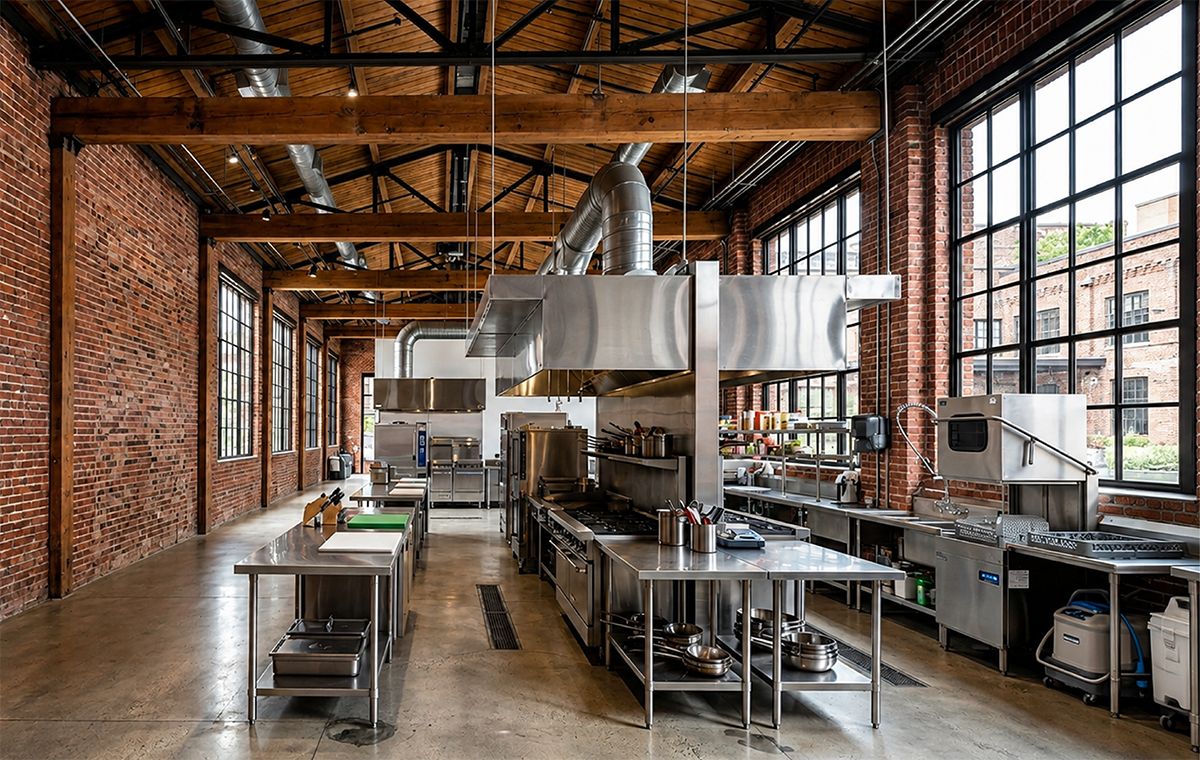
Maybe you’ve stayed at a hotel that was once something entirely different, such as a bustling factory or mill. Or your children attend school at a centuries-old campus but enjoy their meals in a newly renovated dining hall. If so, you’ve been part of one of the biggest trends in commercial real estate: adaptive reuse. Here, instead of tearing down aging structures and starting over, old buildings get a second chance. Retrofitting could be a challenging undertaking, especially for reuses that require commercial kitchens. In this post, we’ll explore some challenges and solutions of building a commercial kitchen in an adaptive reuse building.
Why Adaptive Reuse?
The trend of repurposing old structures such as warehouses, schools, banks, and train stations for new uses has real momentum behind it. The adaptive reuse market is anticipated to expand from $22.2 billion in 2024 to $94.6 billion by 2034, according to Global Insight Services. This data includes buildings for the following three markets that require commercial kitchens. First is hospitality/foodservice, where hotels, restaurants, and catering facilities need to feed guests. Then educational, which includes public schools, universities/colleges, and culinary schools. The third is healthcare/senior living, such as hospitals with patient/staff dining, nursing homes/assisted living, and mental health facilities where residents and staff need to be fed. Beyond that, you have other markets such as institutional/government, and specialty facilities such as museums or community centers.
The primary driver of adaptive reuse is sustainability. Renovation projects can save 50–75% of the embodied carbon emissions when compared to new construction, according to the American Institute of Architects. Also, in many situations, preservation is less costly than building from scratch, and often faster to complete. This is especially true for sprawling institutions such as universities and hospitals that have many buildings on the property.
Building a Modern Kitchen within an Old Shell
The beauty of intricate architecture, exposed brick and steel sash windows comes with a catch. These buildings were never meant to support modern commercial kitchens. Many operators and contractors are faced with the same challenges:
- Limited Space and Awkward Footprints – historic buildings weren’t laid out with a back-of-house workflow in mind. So kitchens often need to be squeezed into whatever space is available after significant historical parts of the structure are preserved. Conditions usually consist of tight corners, low ceilings, oddly shaped rooms, and support columns in the most inconvenient locations.
- Ancient or Absent Mechanical Infrastructure – Original boilers, water heaters, and piping were sized to accommodate the equipment of the past. This means retrofitting a central water heater to serve today’s needs requires running new pipe through walls, ceilings, and other elements that the preservation advocates would rather not see disturbed.
- Even in cases where a central heater can be installed, getting the hot water to where it’s needed requires long runs of pipe. It’s costly to get this done, and translates to heat loss, higher energy consumption, and more opportunities for leaks in places that are difficult to access.
- Code/Compliance Pressures – in addition to these frustrating structural and logistical limitations, developers must deal with non-negotiable health codes as well. These include ones for sanitation, hot water temperature, and handwashing.
Equipment that Accommodates the Space
The challenges presented by adaptive reuse are exactly the ones space-saving kitchen equipment, such as booster and compact water heaters, were designed to solve. Here’s how the primary heater types solve various issues:
- Booster Heaters – these heaters raise water to 180° F, mandated temperatures for dishwasher sanitization, without requiring the building’s water heating system to be upsized. And they will use far less energy to get it done. Booster heaters generally come in 6 and 16 gallon capacities, making them compact and easy to fit within a reuse footprint.
- Compact Point-of-Use Heaters – these take the concept a step further, eliminating the need for long pipe runs from a central supply altogether. Point-of-use heaters supply up to code hot water to handwash and prep stations, or anywhere else it’s needed. The compact system allows for quick installation and less disruption to historic structural elements, along with lower energy waste with smaller mechanical footprints.
- Food Rethermalizers and Bain Marie Heaters – many adaptive reuse projects such as senior living communities, hospitals, and smaller hospitality kitchens might not have room for full scale cook lines. Instead, they work with third-party foodservice companies to supply prepared meals. But they need to stay hot. Rethermalization relies on hot water to allow these operations to hold and safely reheat prepared food. For facilities with larger kitchens, that are able to prepare in-house, these heaters will keep food hot for longer periods of time for buffets, soup stations, and other point of service uses.
- Sanitizing Sink Heaters – found in kitchens and sometimes in front of the house operations such as bars, the multi compartment sinks require consistent and continuous rinse water to properly sanitize dishes, glassware, cookware, and much more. Under-sink models are ideal for space limited applications, while larger models can support more flexible situations.
Conclusion
Adaptive reuse is here to stay. Universities, hospital systems, hospitality groups and many others will continue to rely on this approach as a faster and more sustainable alternative to new construction. But the buildings themselves rarely make the mechanical side of things easy. Thankfully, for foodservice hot water needs, many compact and efficient solutions are available. When properly configured, they will allow operators to meet modern kitchen standards and needs in impressive historical spaces.
Working on an adaptive reuse project? If so, whatever phase you are in, we’d love to help you solve your kitchen hot water heating challenges. We offer a full line of booster heaters in various configurations to accommodate even the most challenging historic building environments out to our application engineering team with your needs today. Fun Fact - Few can relate to adaptive reuse better than us, as we are proudly headquartered in a century-old brick mill building that spans almost four blocks!